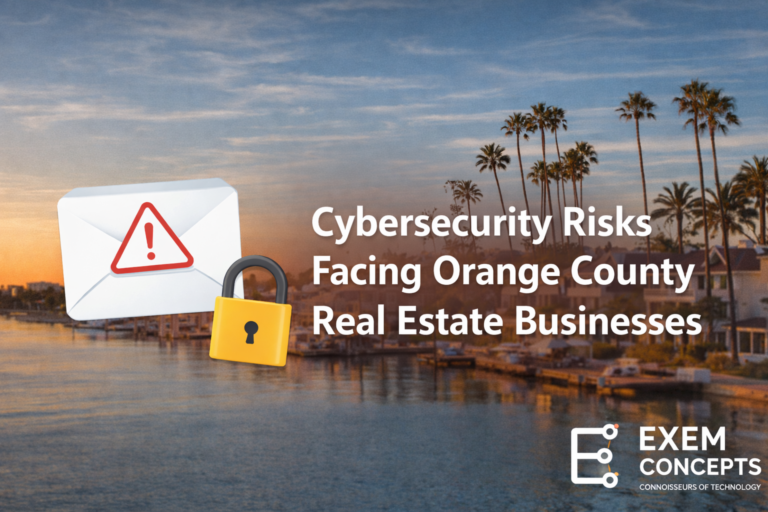
Many SMB owners believe cloud storage reduces phishing risk. In reality, a single phishing email can lead to credential theft, business email fraud, ransomware, and network wide attacks.
At lunch recently, I was talking with a business owner who told me he wasn’t worried about phishing.
“Everything is in the cloud,” he said.
His thinking was straightforward. If an employee clicked a phishing email and a computer became infected, we could clean up the machine, reconnect to our cloud services, and get back to business.
At first, that sounds reasonable.
Then I realized we were looking at two completely different threats.
He was thinking about damaged files.
Modern hackers are thinking about stolen identities.
That distinction matters because today’s phishing attacks often are not trying to destroy your data. They are trying to gain access to your email, cloud applications, financial systems, business relationships, and anything else your employees can access.
Unfortunately, thanks to AI, gaining that access has become easier than ever.
Can a Phishing Email Compromise a Business That Uses Cloud Storage?
Yes.
Cloud storage helps businesses recover data, but it does not prevent attackers from stealing credentials, accessing cloud accounts, installing malware, moving through a network, stealing customer information, or committing financial fraud.
Modern phishing attacks increasingly target user identities, email accounts, cloud applications, and trusted business relationships rather than just files stored on local servers.
The Most Important Idea in This Article
Cloud storage is a data recovery solution.
It is not an identity security solution.
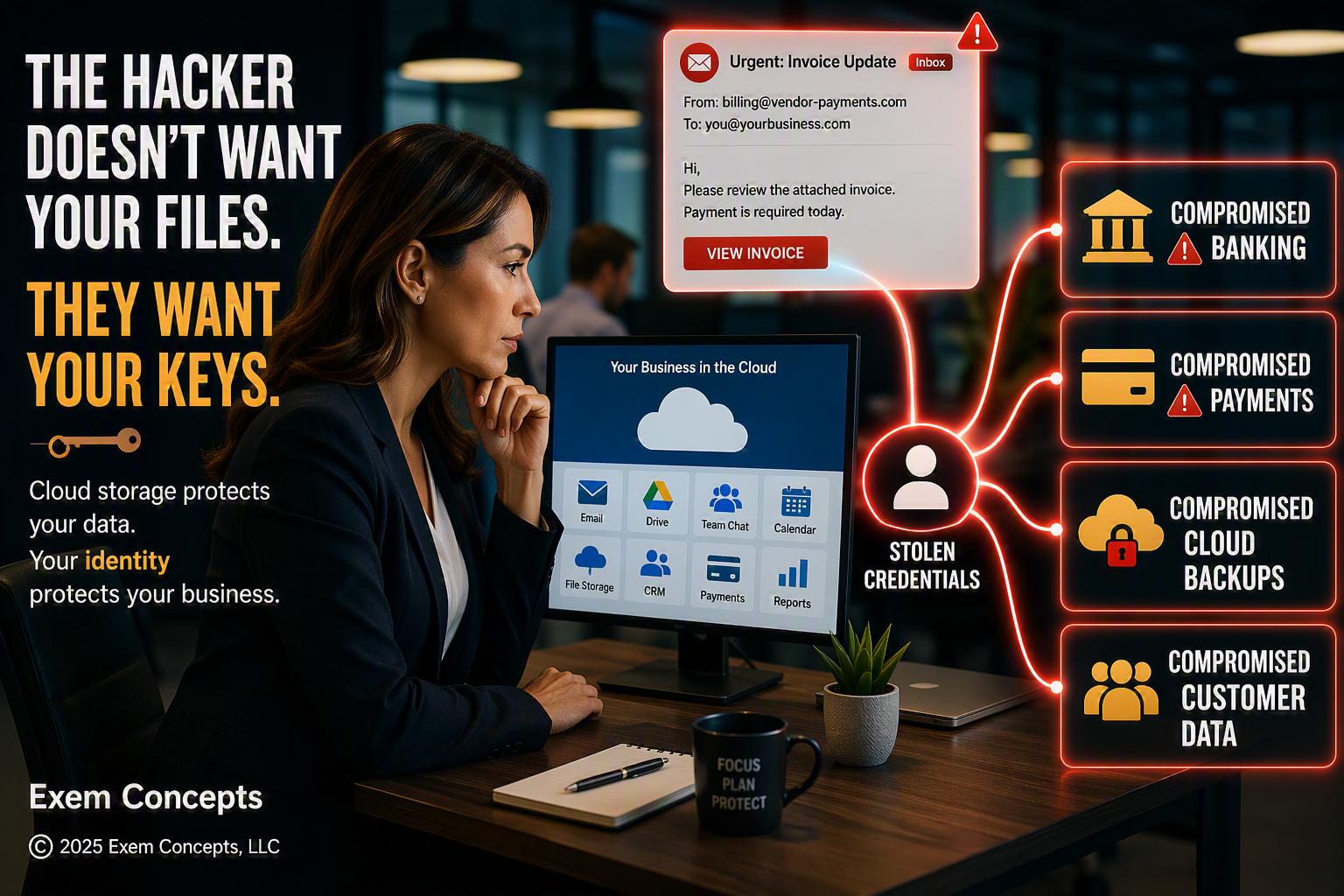
If attackers steal the identity of a trusted employee, they may be able to access the same cloud files, email systems, payment platforms, backups, and business applications that employee uses every day.
And that is where many business owners develop a false sense of security.
The discussion should not be:
“Is our data in the cloud?”
The discussion should be:
“What can an attacker access if they compromise one of our employees?”
That single question changes the entire conversation.
Why Cloud Storage Does Not Stop Phishing Attacks
Let’s start with some good news.
Cloud storage is fantastic.
It protects against hardware failures, accidental deletions, flooded server rooms, and that employee who somehow drags an entire folder structure into oblivion and insists they “did not touch anything.”
What cloud storage does not do is prevent someone from logging in as a legitimate user.
Think about your office building.
Putting important documents in a fireproof cabinet is a smart idea.
But if a burglar steals the keys to the office, the cabinet is not your biggest concern anymore.
That is exactly what many modern phishing attacks are designed to accomplish.
They do not necessarily want your files.
They want the keys.
Many SMB owners invest heavily in cloud storage and backup solutions but spend far less time evaluating email security, phishing protection, employee security training, and account security controls.
Unfortunately, attackers understand this.
They know that gaining access to one employee account can often provide access to the same cloud applications and business systems employees use every day.
This is where many business owners develop a false sense of security.
“We use cloud email.”
“Our payment processing system is in the cloud.”
“Our files are stored online.”
“Our backups are stored in the cloud.”
“Our accounting software is cloud based.”
Those statements may all be true.
But they all assume the attacker is targeting the platform.
If an employee clicks a phishing email and an attacker gains access to their credentials, browser session, or authentication token, the attacker may gain access to the same business systems and cloud services that employee uses every day.
AI Has Changed the Math
There was a time when launching a convincing phishing attack required real skill.
Attackers had to research targets, create believable messages, build fake websites, and customize attacks for individual organizations.
AI has dramatically changed that equation.
Today’s attackers can generate realistic emails in seconds, imitate vendors and coworkers, and create highly personalized messages at a scale that was previously impractical.
The cybersecurity industry often refers to this as “Phishing as a Service.”
Think of it as the subscription economy taking a very unfortunate turn.
Many cybercriminals no longer need advanced technical skills. They can rent tools, automate campaigns, and launch professional looking attacks in minutes.
The result is simple.
The cost of launching attacks has dropped.
The quality of attacks has improved.
And human beings still have busy days, overflowing inboxes, and moments of distraction.
The attacker only needs one mistake.
The business has to get it right every time.
What Happens After an Employee Clicks a Phishing Email?
Most people imagine a phishing attack ending when someone clicks the link.
In reality, that is often where the attack begins.
Once inside, attackers frequently spend time learning how the business works.
Who approves payments?
Who talks to vendors?
Who handles payroll?
Which employee tends to act quickly when the owner asks for something urgent?
Cybercriminals are remarkably patient when someone else’s money is involved.
By the time suspicious activity is discovered, the attacker may already understand the organization’s processes, relationships, and weaknesses.
Many modern phishing attacks are designed specifically to steal credentials rather than deploy malware.
Once credentials are compromised, attackers may gain access to email, cloud storage, collaboration platforms, payment systems, accounting software, and other applications connected to the employee’s account.
What begins as a single phishing email can become access to multiple cloud applications, business systems, financial processes, and sensitive information.
The Cloud Trusts Users. Hackers Know It.
This is where many business owners unintentionally misunderstand cloud security.
Cloud platforms are designed to trust authorized users.
That is their purpose.
A cloud application does not know whether the person logging in is:
- Susan from accounting
- Jim from operations
- Or a criminal sitting halfway across the world using Susan’s credentials
If the authentication appears legitimate, the system generally treats the user as legitimate.
This is not a flaw in cloud technology.
The burglar did not break into the vault.
They stole the customer’s key.
That same principle applies to nearly every cloud application used by modern businesses.
Consider how many business critical systems are now delivered through the cloud:
- Email platforms
- Accounting software
- CRM platforms
- Practice management systems
- Payment processing applications
- File sharing platforms
- Collaboration tools
- Backup repositories
These services can be highly secure.
But they all share one common challenge.
They trust authenticated users.
If an attacker steals the credentials, browser session, or authentication token of an authorized employee, they may gain access to the same systems that employee uses every day.
Cloud applications are productivity tools.
They are not identity security tools.
The Most Expensive Damage May Be Invisible
When business owners think about cyberattacks, they often picture broken technology.
The larger losses are frequently business losses.
For many businesses, trust is not just important.
Dental practices. Law firms. Accounting firms. Healthcare organizations. Financial services firms.
Trust is the product.
And unlike a computer, trust does not come with a restore button.
Final Thoughts
The business owner I spoke with at lunch was correct about one thing.
Cloud storage is incredibly valuable.
It helps businesses recover from hardware failures, accidental deletions, and many forms of data loss.
But that was never the real question.
The real question is what happens when a hacker gains the same access your employees already have.
Because once trusted access is compromised, the location of the data matters far less than the identity accessing it.
Modern phishing attacks are increasingly designed to steal trusted access rather than destroy data.
Cloud storage can restore files.
It cannot restore stolen credentials.
It cannot restore customer trust.
And it certainly cannot restore money sent to a criminal’s bank account.
Cloud storage is a data recovery solution.
It is not an identity security solution.
Complimentary Email Security Assessment
If you are reading this and wondering whether a single phishing email could expose your email environment, cloud applications, payment systems, or business data, there is a simple way to find out.
Exem Concepts offers a complimentary email security assessment designed to help SMBs evaluate their current email security posture, review cloud security protections, identify potential vulnerabilities, and determine whether the right safeguards are in place to defend against modern phishing attacks.
A short assessment today could help prevent a very expensive lesson tomorrow.
Contact Exem Concepts today to schedule your complimentary email security assessment.